


.png)
Pipe, valve, and fitting (PVF) distribution serves critical infrastructure sectors: oil and gas, water treatment, chemical processing, HVAC, and construction. It's also one of the most complex categories in industrial procurement, with thousands of SKUs across varying sizes, materials, pressure ratings, and connection types.
Traditional PVF distribution relied on phone orders, faxed quotes, and sales rep relationships. But buyer expectations have shifted. Contractors and procurement teams want to check availability, compare specifications, and place orders online, often outside business hours. Shopify provides the B2B infrastructure PVF distributors need to serve these buyers while managing the complexity inherent to the category.
The broader industrial distribution market is projected to reach $10 trillion in North America by 2028, yet only about 7% of industrial sales currently happen online. That gap represents significant opportunity for distributors who move early.
Several factors are pushing PVF distributors toward ecommerce:
Buyer behavior has changed. Over 80% of B2B buyers report dissatisfaction with current vendor experiences, and 74% say they'd switch suppliers for better digital options. Younger procurement professionals expect the same convenience they experience as consumers.
Self-service is expected. Buyers want to check stock, view pricing, and place orders without waiting for a sales rep callback. They need 24/7 access to your catalog, especially when urgent repairs require immediate parts.
Competition is intensifying. Online marketplaces and digitally-native competitors are capturing market share from traditional distributors who haven't modernized.
Operational efficiency matters. Manual order entry, phone quotes, and disconnected systems create overhead. Digital ordering reduces errors and frees your team for higher-value activities.
PVF catalogs present a unique challenge. A single product family can generate thousands of SKUs when you account for all variations.
Consider a basic hydraulic hose: eight bore sizes, six reinforcement options, nine end-fitting types, and 20 length increments yields 8,640 discrete SKUs for one product family. Multiply that across pipe, fittings, flanges, valves, and gaskets, and you're managing a massive catalog.
Structure your Shopify catalog so buyers can navigate efficiently:
PVF buyers search by technical specifications, not marketing descriptions. Configure your product data to support filtering by:
For guidance on implementing specification-based filtering, see Granular Filter and Search for Niche B2B Products on Shopify.
With thousands of SKUs and dozens of attributes per product, data management becomes critical. Errors in specifications can lead to wrong orders, project delays, and safety issues.
A Product Information Management (PIM) system centralizes your product data and syncs it to Shopify, ensuring consistency across your catalog. PIM also enables bulk updates when specifications change or new products are added.
For more on PIM integration, see How a PIM Can Revolutionize Your B2B Shopify Store.
Industrial buyers need more than photos and descriptions. Before purchasing, they need to verify that products meet project specifications and compliance requirements.
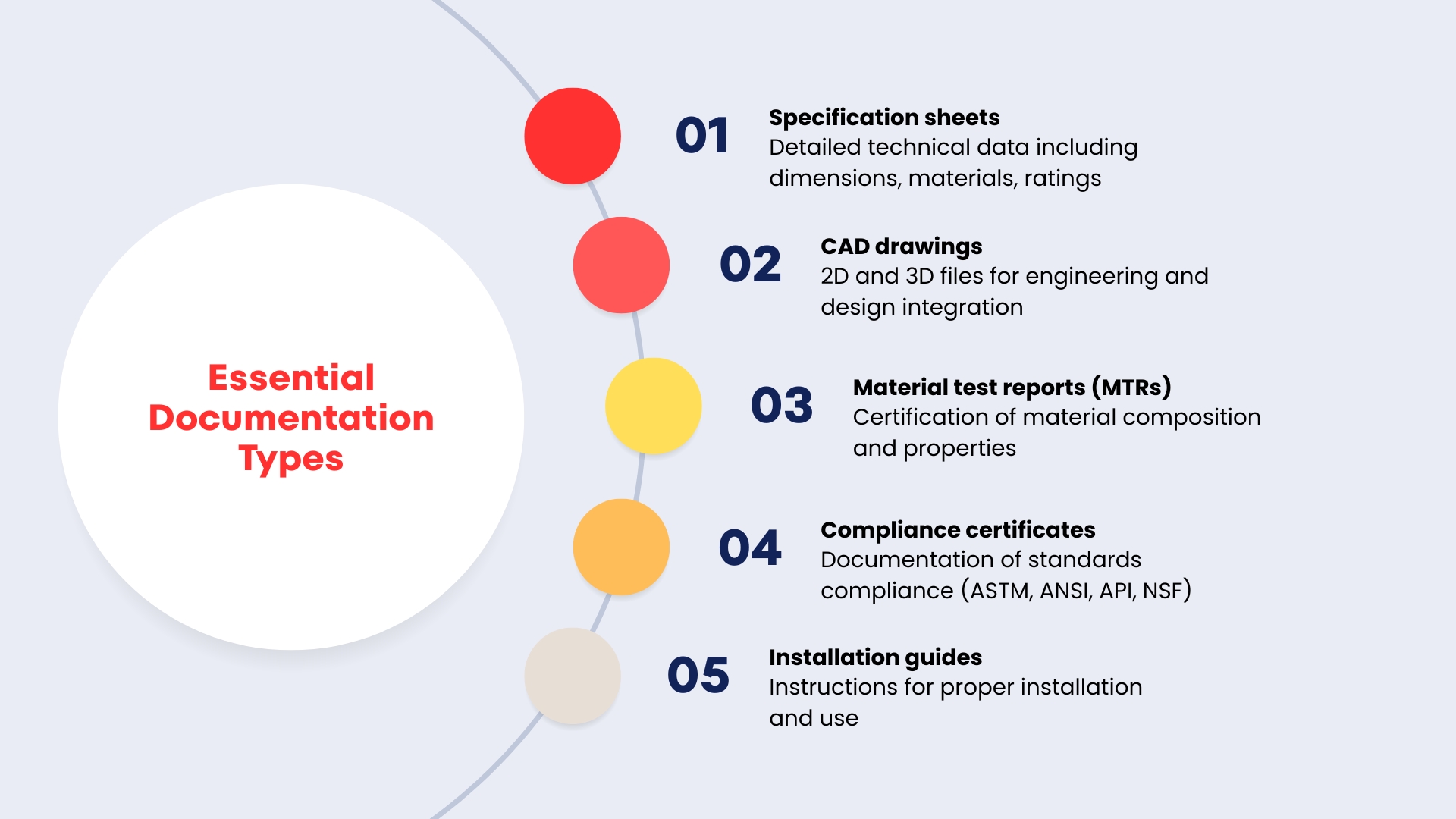
Attach documentation directly to product pages so buyers can download what they need during the evaluation process. This self-service access reduces support inquiries and speeds up purchasing decisions.
For implementation guidance, see Spec Sheet and CAD Downloads for Shopify Product Pages.
PVF pricing is rarely straightforward. Different customers pay different prices based on volume commitments, relationship history, and negotiated contracts.
Shopify's B2B features support price lists assigned to specific companies or company locations. This means:
Configure price lists in your Shopify admin and assign them to company accounts. For detailed setup instructions, see Customer-Specific Pricing on Shopify for B2B.
PVF orders often qualify for quantity breaks. A contractor ordering 100 fittings should pay less per unit than someone ordering 10.
Set up volume pricing tiers that automatically apply when order quantities reach thresholds. For configuration guidance, see Volume-Based Pricing and MOQs on Shopify.
Raw material costs (steel, copper, brass, plastics) fluctuate, sometimes significantly. PVF distributors need flexibility to adjust pricing as costs change.
Shopify's price list structure allows you to update pricing centrally and have changes flow to all assigned customers. For volatile categories, consider whether real-time ERP pricing integration makes sense for your operation.
PVF customers typically operate on payment terms rather than paying at checkout. Contractors and industrial buyers expect net 30, net 60, or longer terms based on their creditworthiness.
Shopify B2B supports standard payment terms:
Assign terms at the company level so each customer checks out with their agreed-upon terms. For detailed configuration, see Net 90, Deposits, and Other Unique Payment Terms on Shopify.
Before extending terms to new accounts, establish a credit approval process. This might include:
For more on managing customer approvals, see Using Shopify Flow to Automate Customer Approval Processes.
PVF buyers often reorder the same items repeatedly. A plumbing contractor might order the same fittings weekly. An industrial maintenance team restocks the same valve repair kits monthly.
Make reordering effortless:
These features reduce friction for repeat customers and increase order frequency. For implementation details, see Quick Orders, CSV Uploads, and Effortless Re-Ordering for B2B Shopify.
Not everything in PVF distribution sells at fixed prices. Large projects, custom fabrication, and special orders often require quotes.
Enable customers to request quotes directly from your store:
This workflow handles scenarios where pricing depends on current material costs, quantity, or custom requirements. For setup guidance, see RFQ Popups and Direct Sales Contact on B2B Shopify.
Shopify's draft order functionality lets your sales team build orders manually, apply custom pricing, and send invoices for customer approval. This works well for:
PVF distributors typically run ERP systems that manage inventory, pricing, customers, and accounting. Your ecommerce platform needs to connect with these systems rather than operate in isolation.
Shopify supports integration through APIs, pre-built connectors, and middleware platforms. The right approach depends on your ERP system and integration complexity.
For general guidance, see Shopify ERP Integration Guide. For specific platforms, see our guides on Acumatica-Shopify Connector and Microsoft Dynamics 365 Business Central.
PVF customers often have multiple job sites, branches, or warehouses. A regional contractor might have a main office plus five satellite locations, each needing to place orders and receive shipments.
Shopify B2B supports company profiles with multiple locations (up to 10,000 locations per parent company). This structure allows:
If certain products are only available in specific regions (due to inventory allocation or regulatory restrictions), you can control product visibility by customer location.
Large PVF orders warrant review before fulfillment. A $50,000 pipe order to a new customer shouldn't ship without verification.
Configure orders meeting certain criteria to submit as drafts for your review:
This gives your team the opportunity to verify credit, confirm inventory, and catch any issues before committing to fulfillment. For detailed guidance, see How to Set Up B2B Order Review Workflows in Shopify.
PVF products present unique fulfillment challenges: heavy items, long lengths, hazardous materials, and freight shipping requirements.
Route orders to the appropriate fulfillment path based on product characteristics, shipping destination, or customer preference. For routing configuration, see Order Routing Logic in Shopify.
For setting up local pickup, see How to Offer In-Store Pickup for B2B Customers on Shopify.
Moving PVF distribution online doesn't require launching everything at once. Consider a phased approach:
The goal is giving your customers a better way to do business with you while reducing the manual effort required from your team. PVF buyers want the convenience of online ordering combined with the expertise and reliability they expect from their distributor relationships.
For a broader overview of B2B capabilities, see Essential Shopify Features for B2B.

.png)
